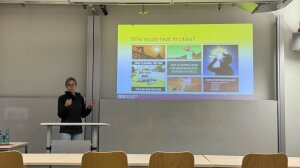
Last Wednesday, November 26, 2025, Prof. Ariane Middel from the Arizona State University (ASU) gave a lecture titled “Heat exposure in cities – Novel sensing and modeling to build heat resilience” as part of the GI colloquium. In gray Bochum November weather and with Christmas treats, she spoke about her work on investigating heat stress and adaptation measures in the Phoenix Metropolitan Region. Phoenix is particularly affected by heat stress: in 2023, air temperatures exceeded 43°C for 31 consecutive days, and even at night, the region only cooled down to 36°C on extreme days. As part of her research at the SHaDE Lab of ASU, she conducts measurement campaigns to characterize different locations and surfaces in terms of their thermal effects on humans and to examine the effectiveness of adaptation measures such as shade, water misting, green infrastructure, or “Cool Pavements,” which are cooling pavement surfaces. She particularly mentioned the trade-offs between competing goals, such as municipal costs for artificial irrigation and construction measures, or cooling during the day or night, which are relevant aspects for the implementation of measures by local authorities.
Prof. Middel is currently the president of the International Association for Urban Climate (IAUC), the leading international organization of urban climatology researchers, and is working as a guest scientist at the Bochum Urban Climate Lab at RUB until the end of December.

Copyright © Geographical Institute 2025
Last update: Dez 05, 2025