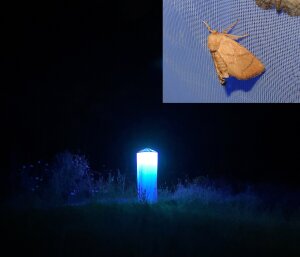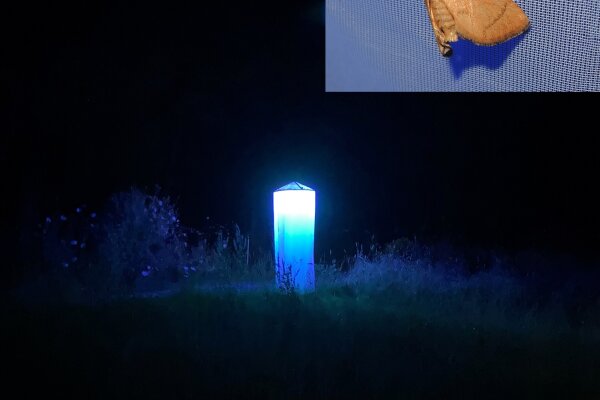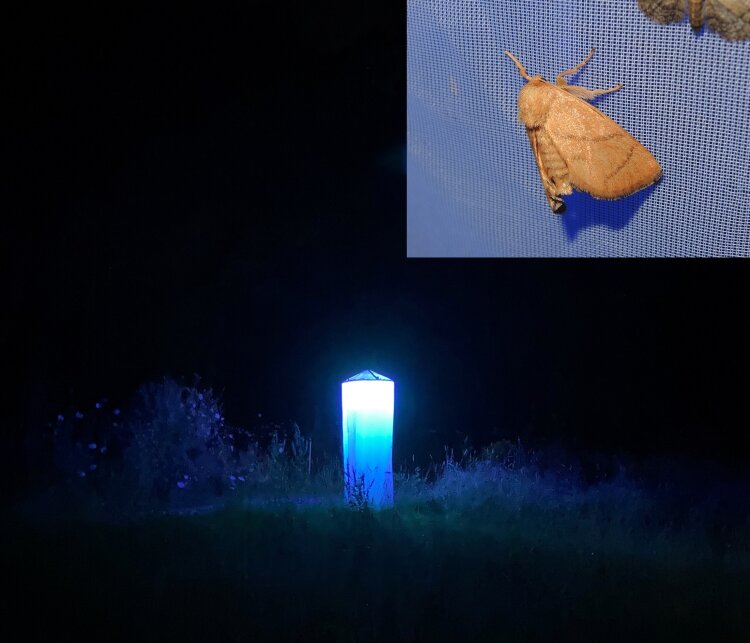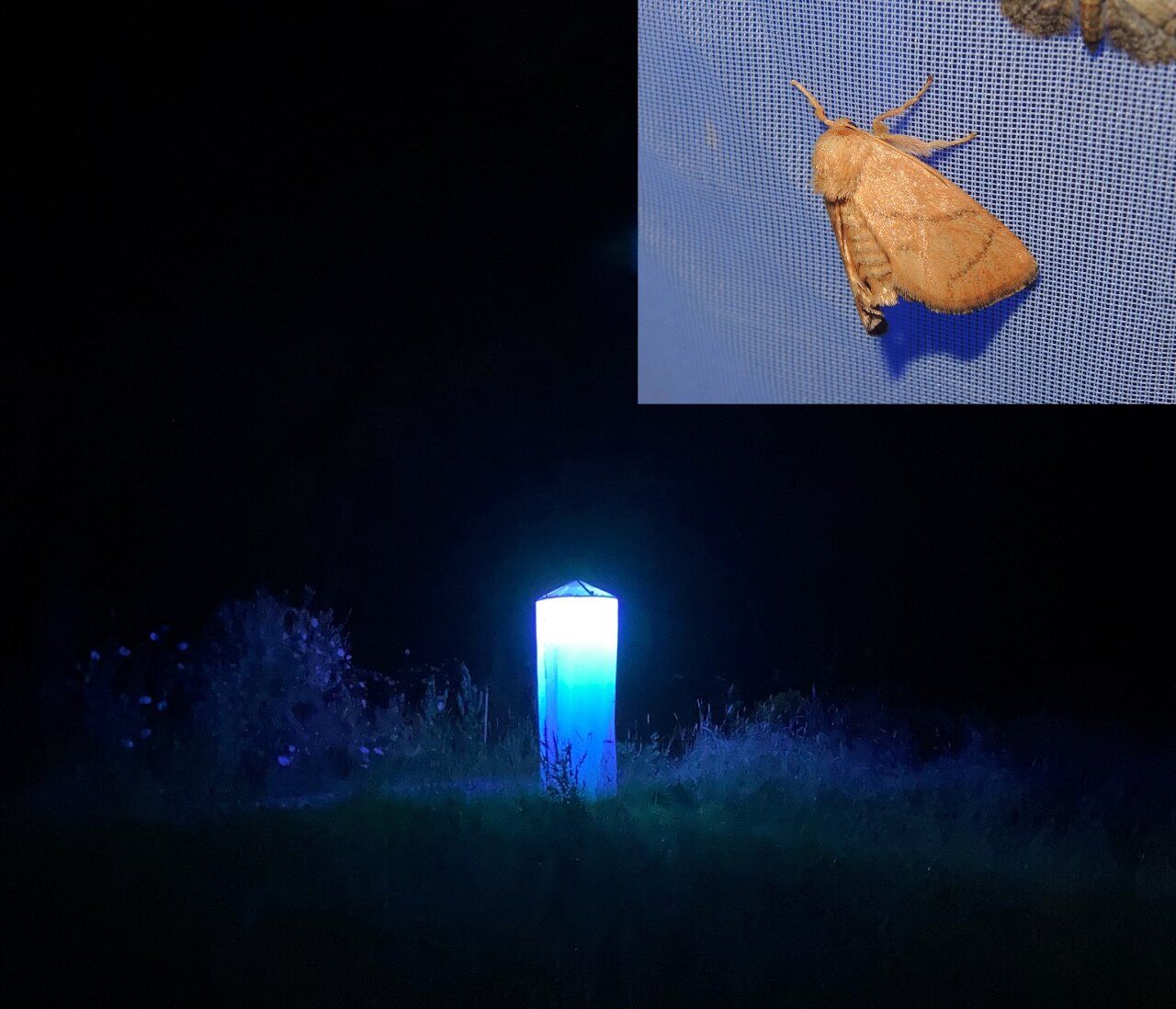
A Look Back at July: On a dark summer night, another “Glow” event with Dr. Armin Jagel took place at the Botanical Garden. As part of the “Measurement and Modeling 1” course in the master’s program in Geography with a specialization in “Urban and Landscape Ecology,” Dr. Jagel (BUND Bochum) introduced students to methods for surveying nocturnal insects, with a focus on moths.
First, during a tour of the dark garden, students were shown species that had gathered on jute strands soaked in a lure. Among them, two large species stood out in particular due to their red hindwings: Catocala nupta and Catocala promissa. Other species also displayed a wide variety of colors and patterns, such as Earias clorana and the Thyatira batis. Over the course of the night, 31 species were attracted to the bait during several rounds of observation.
The moths were then observed at two light towers that had been set up to attract them using special light sources. Conditions were ideal: Since it was the day after the new moon, the moths were not distracted by moonlight. The temperature initially stood at 20 °C and dropped only to 17 °C by 2:30 a.m. Some of the species already found at the bait station were also present at the light, but an additional 43 species were observed, such as Anania hortulata, Habrosyne pyritoides, and Deilephila elpenor. Despite the diversity of moths, however, the most striking sight was probably a male stag beetle that was observed near the tower. A total of 74 moth species were counted in four hours.

Copyright © Geographical Institute 2026
Last update: Okt 19, 2026