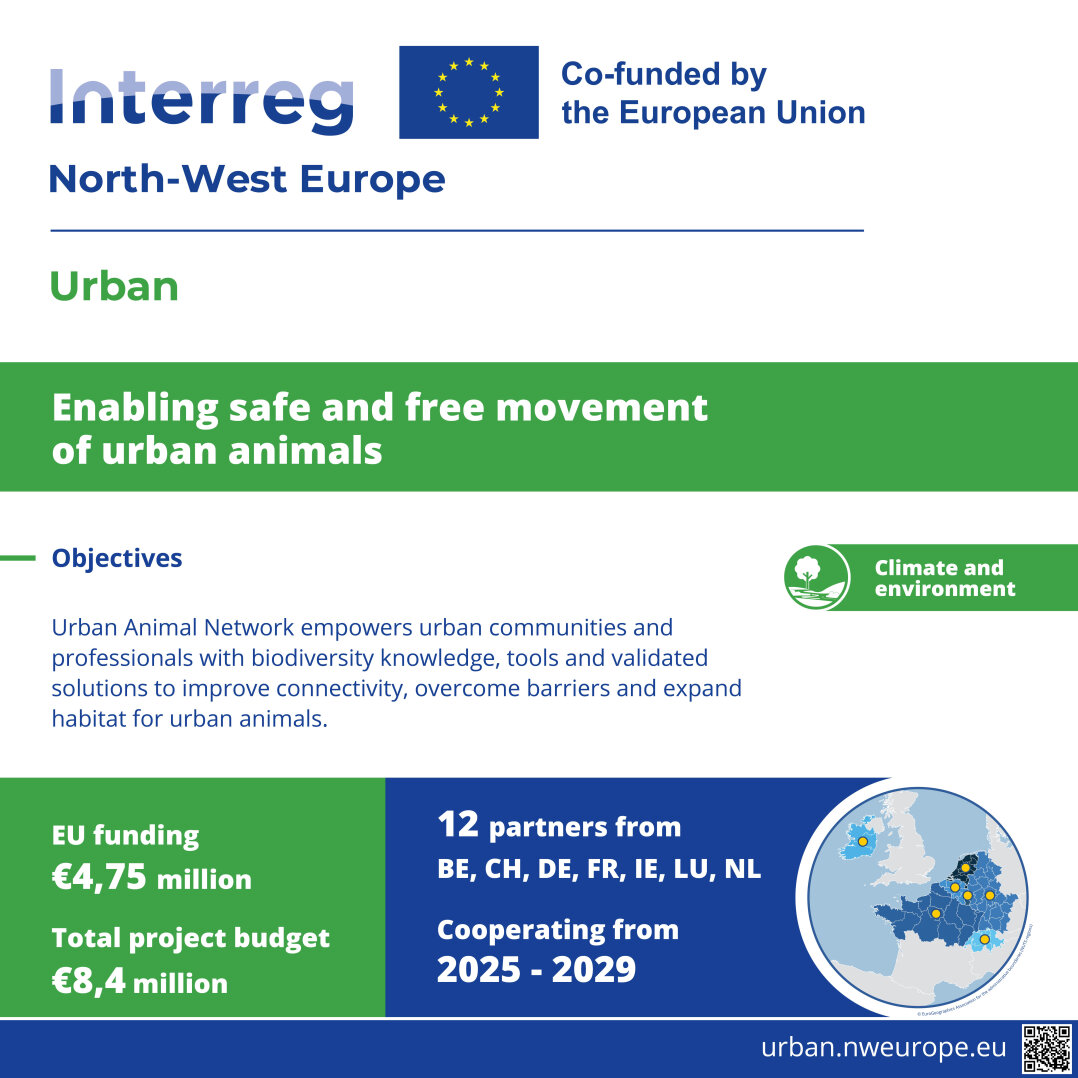
Funding from Interreg NWE is enabling the group to research measures to improve the connectivity of urban habitats for small mammals within the project "URBAN". The project involves 12 partner institutions across north-west Europe and is coordinated by the Dutch municipality of Hilversum. Partner institutions are based in The Netherlands, Belgium, Ireland, France, Switzerland, Germany & Luxembourg. The project runs from November 2025 to April 2029. Find the project flyer here.
Project aim
Urban Animal Network aims at improving urban biodiversity by:
The project focuses on four ecological layers in cities:
The project has the following goals for the pilot areas:
Project partners
European subsidy
The project is made possible by European cofunding from the programme Interreg Northwest Europe. URBAN (Animal Network) has a total budget of €8.4 million, of which €4.8 million is funded by the EU Interreg North-West Europe (NWE) Program.
Project Info
Project Period: 2025 - 2029
Website: https://urban.nweurope.eu/
Team: Participating departments:
Copyright © Geographical Institute 2026
Last update: Okt 30, 2026